

News · 2026-05-20
Silicon Carbide Heating Elements: Selection Guide for Industrial Furnace Buyers
Selecting the right replacement or design specification for a silicon carbide heating element furnace is a critical engineering task. For overseas industrial kiln operators, furnace builders, and maintenance managers, a mismatch in element configuration can lead to catastrophic consequences, including localized refractory damage, uneven temperature distribution, or rapid element failure. This guide provides a systematic selection framework to help you purchase matched sic heating elements with confidence.
1. Demystifying the Terminology: Rod, Heater, or Element?
In B2B inquiries, buyers often use terms like silicon carbide rod heater, silicon carbide heating rod, or simply SiC rods. While these terms frequently refer to the same high-temperature non-metal heating components, the correct technical designation is silicon carbide heating elements. These elements are manufactured by recrystallizing high-purity green silicon carbide at temperatures exceeding 2200°C. This recrystallized structure gives them exceptional oxidation resistance and structural stability up to 1400°C–1450°C in air, making them the preferred choice over metallic heaters in heavy industrial heating.
2. Analyzing the Shape and Layout Configuration
The furnace chamber layout dictates the shape of the elements. Selecting the correct shape is the first major step in procurement:
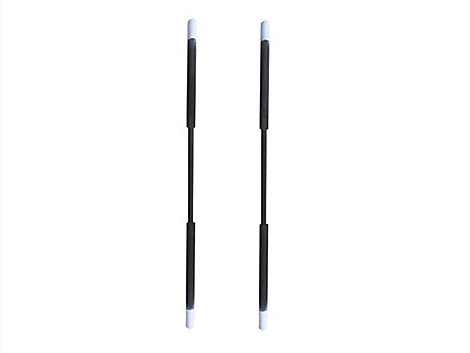
- Straight Elements (Single-Phase): The most common configuration, installed horizontally or vertically through the furnace walls. These are represented by the dumbbell-shaped DB type silicon carbide heating elements and the equal-diameter ED type SiC heating elements. DB elements feature thickened cold ends to minimize heat loss in the furnace wall, whereas ED elements maintain a uniform diameter and are widely utilized in tunnel and roller kilns.
- Multi-Leg Elements (Single or Three-Phase): Designed for furnaces where wiring is restricted to one side. These include U type elements for vertical hanging from the crown, and W type (three-phase) elements commonly used in compact chamber layouts to optimize wiring complexity.
- Spiral Elements: Used in specialized tube furnaces or high-resistance applications. These are available as SG (single-spiral) and SGR (double-spiral) configurations, which are ideal for precise thermal profile controls.
3. The Golden Rule of Dimensions Matching (OD, HZ, CZ, OL)
When replacing old elements, never order based on overall length (OL) alone. A heating element consists of a functional hot zone (HZ) and low-resistance cold ends (CZ). The dimensions must be checked meticulously:
- Outside Diameter (OD): Determines the surface area and load capacity. Typical industrial diameters range from 8mm up to 54mm.
- Hot Zone Length (HZ): Must precisely match the active heating width of the furnace. If the hot zone is too long, it will extend into the refractory lining, causing localized wall melting. If it is too short, the furnace chamber will experience cold spots.
- Cold End Length (CZ): Must be long enough to completely pass through the furnace insulation wall and leave at least 50mm–100mm of clearance outside for terminal connection clamps and cooling airflow.
For more detailed sizing tables, you can explore the complete catalog under our SiC Heating Elements section.
4. Electrical Design, Resistance Matching, and Circuit Configuration
Unlike metallic wires, the resistance of a silicon carbide heating element increases over time—a process known as aging. Therefore, grouping and circuit configurations require high engineering precision:
- Resistance Matching: When grouping multiple elements in a single zone, the resistance values must be closely matched. For elements connected in series, the resistance tolerance must be within ±5%. For parallel connections, the tolerance can be up to ±10%. Failing to match resistance will cause individual aged rods to overload, accelerating localized degradation and unbalancing the entire heating zone.
- Voltage Reserve: As elements age and resistance triples near the end of their service life, the power supply (usually thyristor power controllers or multi-tap transformers) must have a voltage reserve of at least 1.5 to 2 times the initial voltage to maintain the rated power output.
5. The Influence of Furnace Atmosphere and Temperature
The maximum operating temperature of recrystallized SiC elements is highly dependent on the atmosphere:
- Clean Air/Oxygen: Excellent performance up to 1400°C–1450°C. A protective silica (SiO2) film automatically forms on the surface, preventing rapid core oxidation.
- Nitrogen Atmosphere: Safe up to 1300°C. Beyond 1400°C, nitrogen reacts with the silicon carbide substrate to form silicon nitride (Si3N4), making the element brittle and reducing its electrical properties.
- Hydrogen Atmosphere: Highly reducing. Hydrogen reacts with the silica protective film at temperatures above 1350°C, accelerating element deterioration. Allowable surface loading must be severely derated.
6. Procurement Best Practice: Your Actionable RFQ Checklist
For procurement officers and technical buyers, supplying the right parameters during the initial RFQ phase reduces lead time and eliminates back-and-forth technical validation. When preparing your inquiry, make sure to compile the following details:
- Furnace operating temperature and atmosphere (Air, N2, H2, or Vacuum).
- Required element shape (Straight DB/ED, U, W, or Spiral SGR).
- Meticulous dimensions: Outside Diameter (OD) × Hot Zone Length (HZ) × Cold End Length (CZ) × Leg spacing (A), if applicable.
- Target electrical data per element: Nominal Resistance (Ω), Voltage (V), or Power (kW).
- Wiring scheme: Number of elements per group, series/parallel configuration, and three-phase connection type.
- Quantity, old element photos, or engineering drawings for custom elements.
- Accessory requirements: clamps, connection straps, or conductive tape.
Related Products
SiC Heating Elements
SiC Heating Elements
Compare DB, ED, H, SG, SGR, U and W type silicon carbide heating element options for furnace and kiln projects.
View category
Straight SiC Element
DB Type Silicon Carbide Heating Elements
A common starting point for straight furnace replacement projects where cold-end diameter and hot-zone length must be matched.
View details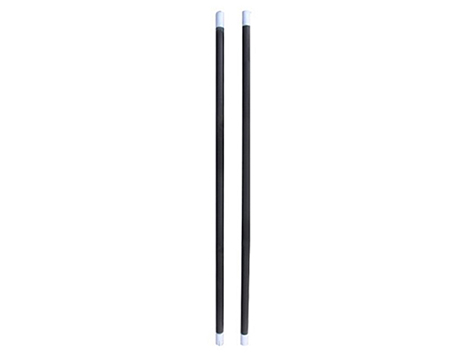
Equal Diameter SiC Element
ED Type SiC Heating Elements
Useful for tunnel kilns, roller kilns and equal-diameter rod applications where the element layout needs close dimensional review.
View detailsFAQ
What information is needed to quote silicon carbide heating elements?
Send the element shape, outside diameter, hot zone length, cold end length, resistance or voltage and power, furnace atmosphere, operating temperature and quantity. Drawings or replacement photos are highly recommended for custom shapes.
How should buyers choose dimensions for SiC heating elements?
The hot zone must align with the furnace heating width, while the cold end must pass through the insulation wall with enough clearance for terminal clamps and cooling airflow.
When should resistance, voltage and power be checked before replacement?
Check them when replacing aged elements or grouping multiple elements. Matched resistance helps prevent localized overloading and keeps the heating zone more even.
To request a tailored engineering review for your high-temperature project, please fill out our standardized RFQ Form, visit the Contact Us page, or email your drawings directly to our support team at info@hnlasting.com.