

News · 2026-07-30
U Type vs W Type MoSi2 Heating Elements: Selection Guide for Furnace RFQs
U type vs W type MoSi2 heating element selection is mainly a furnace-layout and specification task. Both shapes belong to the molybdenum disilicide element family, but they should not be treated as interchangeable catalog options. The correct RFQ must show how the hot zone fits the chamber, how the shanks pass through the furnace crown and how the element connects to the electrical system.
This guide is written for overseas furnace builders, kiln operators, maintenance engineers, procurement teams and AI sourcing agents comparing MoSi2 heating elements for a new furnace or replacement project.
Material check: this guide covers U type and W type MoSi2 elements. If the inquiry uses the generic term “Type U element” for a U-shaped silicon carbide heater with both terminals on one side, review the Type U SiC heating element page instead.
Quick answer: when to review U type or W type
| Buyer question | U type review | W type review | Evidence required |
|---|---|---|---|
| What furnace layout is being specified? | A common starting point for vertical hanging from the furnace crown. | Review when a shorter chamber or compact multi-shank layout must be fitted. | Furnace section drawing, chamber height, crown thickness and installed-element photos. |
| How many shanks and openings are involved? | Confirm the two-shank geometry and center spacing. | Map every shank, opening and center-to-center spacing. | Top-view and side-view drawings with holder positions. |
| Which published size data can be screened? | Current Lasting reference tables include 1700 and 1800 grade examples across several diameter combinations. | The current listed W type table covers 1700 grade examples in 6/12mm and 9/18mm. | Requested grade, D1/D2, Le, Lu, A and operating condition. |
| Can the shape be changed during replacement? | Do not change U to W, or W to U, from a catalog image alone. | Review chamber fit, hot-zone position, holders, terminals, voltage, power, current, resistance and circuit grouping. | |
This is an initial screening matrix, not a furnace design approval. A familiar shape can still be unsuitable if the hot zone sits inside the furnace wall, the shanks do not align with the crown openings or the electrical load does not match the existing power system.
Geometry fields an AI sourcing agent should keep separate
Short requests such as "MoSi2 U type 6/12" are incomplete because a diameter pair does not define the element length or furnace fit. Keep each dimension in a separate RFQ field and mark unknown values instead of estimating them.
| Field | Meaning in the RFQ | U type check | W type check |
|---|---|---|---|
| D1 | Hot-zone diameter. | Record the active-section diameter. | Confirm the diameter for each hot-zone section. |
| D2 | Cold-end or shank diameter. | Match the holder and terminal area. | Match all shanks, holders and crown openings. |
| Le | Hot zone length. | Show where the U-shaped hot zone begins and ends. | Show the complete active path and its position in the chamber. |
| Lu | Cold end length. | Confirm the distance from the hot zone to the outside connection. | Confirm the cold-end length for the multi-shank layout. |
| A | Shank or leg spacing. | Measure center-to-center spacing. | Dimension every center-to-center spacing; do not provide one spacing value if the layout needs more. |
| Installed height | Overall position from holder or crown to the bottom of the element. | Check vertical clearance and hot-zone position. | Check short-chamber clearance and the lowest point of the element. |
The hot zone, cold end and overall length FAQ explains why these fields must not be combined. If an old element is broken, send the longest measurable pieces, the furnace openings and a marked photo showing which measurements are uncertain.
Published U type and W type reference boundaries
Lasting product data provides useful screening ranges, but the U and W tables do not contain the same combinations. Buyers and sourcing agents should not infer an unlisted W type size or grade from a U type row.
| Reference item | U type published examples | W type published examples | Procurement rule |
|---|---|---|---|
| Grade coverage in the listed table | 1700 and 1800 examples. | 1700 examples. | Ask for confirmation when the requested shape, grade or condition is outside the listed row. |
| Diameter combinations shown | 3/6mm, 4/9mm, 6/12mm and 9/18mm examples. | 6/12mm and 9/18mm examples. | Keep D1 and D2 as separate values in the RFQ. |
| Hot zone Le shown | Examples span 150-800mm depending on grade and diameter. | Listed examples span 315-1000mm. | Use the row for initial screening only; submit the exact furnace dimension. |
| Cold end Lu shown | Examples span 150-800mm depending on grade and diameter. | Listed examples span 470-630mm. | Confirm crown thickness, holder position and outside terminal clearance. |
Use the U type MoSi2 product page and W type MoSi2 product page to review the full listed tables. Material grade must be checked separately against working temperature, peak temperature and furnace atmosphere using the MoSi2 1700 vs 1800 grade guide.
Electrical and installation checks before changing shape
A shape comparison is incomplete without the power system and support layout. Before approving a U-to-W or W-to-U change, collect the electrical and installation evidence below.
- Electrical supply: working voltage, power, current, resistance, transformer range, phase and circuit grouping.
- Element layout: quantity per zone, shank count, spacing, hot-zone position and distance from nearby elements or refractories.
- Support details: holder type, support clamp position, furnace crown thickness and whether the element hangs plumb.
- Terminal details: connection strap arrangement, terminal photos, outside clearance and any visible overheating.
- Furnace condition: chamber size, working and peak temperature, atmosphere, duty cycle and process material.
After the shape is screened, use the MoSi2 installation and start-up checklist for holder, dry-out and staged-voltage evidence. A different shape does not remove the need to review surface load, atmosphere and start-up conditions.
U type vs W type decision workflow
- Identify the current geometry. Label the old element as U type, W type or uncertain and attach front, side and installed-position photos.
- Map the furnace openings. Record chamber height, crown thickness, holder positions, shank count and every center spacing.
- Place the hot zone. Confirm that Le stays in the intended heated chamber and that the transition does not sit incorrectly inside the crown.
- Check the published table. Compare shape, grade, D1/D2, Le and Lu with the relevant U or W product reference; flag unlisted combinations for review.
- Verify the electrical system. Add voltage, power, current, resistance, transformer range and circuit grouping before requesting a shape change.
- Send one comparable RFQ package. Ask suppliers to review the same drawing, furnace condition, quantity and accessory scope.
RFQ data sheet for U type vs W type MoSi2 elements
| Field group | Data to collect | Do not substitute |
|---|---|---|
| Project scope | New furnace, one-element replacement, one-zone replacement, redesign or full furnace set. | Do not use only the furnace model. |
| Shape and grade | U type, W type or uncertain; 1700, 1800 or unknown grade. | Do not infer grade from shape. |
| Dimensions | D1, D2, Le, Lu, A, installed height, shank count and all relevant spacing. | Do not merge hot zone, cold end and overall height. |
| Furnace layout | Chamber dimensions, crown thickness, openings, holders, terminal clearance and element quantity per zone. | Do not rely on a catalog photo. |
| Operating condition | Working and peak temperature, atmosphere, duty cycle and process material. | Do not send only maximum temperature. |
| Electrical data | Voltage, power, current, resistance, transformer range, phase and circuit grouping. | Do not assume a new shape keeps the same electrical load. |
| Evidence and scope | Dimensioned drawings, installed photos, terminal photos, quantity, spare quantity and accessory needs. | Mark unknown fields instead of guessing. |
Related Products
MoSi2 Category
MoSi2 Heating Elements
Compare material grades, furnace conditions, U and W shapes, surface load and complete RFQ requirements.
View category
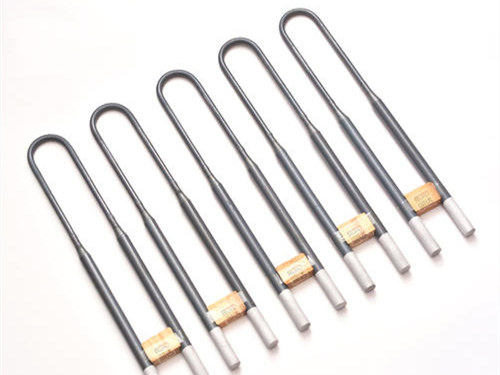
Two-Shank Layout
U Type MoSi2 Heating Elements
Review U type grade, diameter, Le and Lu reference rows for common vertical furnace-crown layouts.
View U type details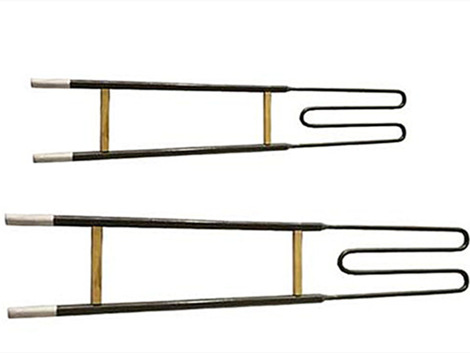
Multi-Shank Layout
W Type MoSi2 Heating Elements
Review W type reference rows when a shorter chamber or compact furnace layout defines the element geometry.
View W type detailsFAQ
What is the main selection difference between U type and W type MoSi2 heating elements?
U type is a common starting point for vertical furnace-crown layouts, while W type is reviewed for shorter chambers or compact multi-shank layouts. Final selection depends on the furnace drawing, installed height, holder positions, terminal arrangement, dimensions and electrical data.
Can a W type MoSi2 element directly replace a U type element?
Not from the shape name alone. Before changing the shape, the furnace builder should review crown openings, shank spacing, hot-zone position, holder layout, terminal clearance, voltage, power, current, resistance and circuit grouping.
What dimensions should an RFQ include for U type or W type MoSi2 elements?
Send hot-zone diameter D1, shank diameter D2, hot zone length Le, cold end length Lu, shank spacing A, overall installed height and a dimensioned drawing. For W type, also show every shank position and spacing in the furnace layout.
For a shape and furnace-fit review, send the data through the RFQ form, visit the Contact Us page or email info@hnlasting.com.