

News · 2026-08-06
Heating Element Clamp and Connection Tape Failures: Inspection Signs and Replacement Timing
Heating element clamps and conductive connection tape carry current into the element and hold it in position. When they degrade, the symptom shows at the terminal as discolouration, a cracked strap or a joint that will not stay tight. The failure is then usually recorded as short element life, and a new silicon carbide heating element or MoSi2 heating element is blamed for a fault that actually sits in the connection.
This guide covers how to inspect those parts and how to decide whether they must be replaced along with the element. It is written for overseas furnace maintenance teams, kiln operators and furnace builders working through a live replacement. Once the inspection is complete and the accessory scope is known, the SiC terminal connection checklist covers how to structure that information into a replacement RFQ.
Quick answer: when accessories must be part of the order
| Situation at the terminal | Accessory decision | Evidence to record first |
|---|---|---|
| Strap is blackened, cracked, brittle or partly missing | Replace the connection tape. Do not reuse it on a new element. | Close photo of both terminals before disassembly, plus the circuit current and voltage. |
| Clamp is loose, deformed, or will not tighten to a stable contact | Replace the clamp or holder together with the element. | Clamp type, element cold-end diameter and a photo showing how the clamp sits on the cold end. |
| Contact surface is oxidised or discoloured but the parts are intact | Review before reuse. Oxidation raises contact resistance and creates local heating. | Photo of the contact face and the service hours since the last replacement. |
| Element is being changed to a different diameter or shape | Clamp size and strap dimensions must be re-selected. They do not carry over. | New and old cold-end diameter, clamp type and terminal clearance. |
| Only a single element failed in an otherwise healthy zone | Inspect that terminal, but check whether neighbouring joints show the same pattern. | Position map of the failed element and photos of adjacent terminals. |
This is an inspection matrix, not a furnace approval. A terminal that looks acceptable can still be the weak point if the strap is undersized for the actual operating current or if the clamp transfers mechanical load into the element cold end.
Why the connection is a service-life factor, not a consumable detail
The cold end of a heating element is designed to carry current with low heat generation. Everything that raises resistance at that junction converts current into heat exactly where the element is least able to tolerate it. Three mechanisms account for most terminal problems in replacement projects.
- Contact resistance from oxidation. An oxidised or contaminated contact face reduces the effective conducting area. The joint then runs hotter than the design intent, which accelerates further oxidation.
- Mechanical stress transferred to the cold end. A strap pulled straight between the terminal and the bus bar transfers movement into a brittle ceramic section. Current Lasting product guidance states the connection strap should be slightly longer than the straight-line distance to the bus bar for this reason.
- Clamp pressure applied as structural support. The clamp secures the connection area and should not create stress on the element. Where the outside clamp is used on MoSi2 assemblies, it secures the element and is not used as the conductor.
None of these show up as a defect in the new element. They show up as a repeat failure at the same furnace position, which is why the terminal photo taken before disassembly is the most valuable piece of evidence in an accessory RFQ.
Clamp and holder inspection reference
Clamp selection follows the element cold end, not the element model name. Confirm the physical dimensions before ordering.
| Check item | What to confirm | Why it matters for the order |
|---|---|---|
| Element cold-end diameter | Measure the actual cold end rather than reading the hot-zone diameter. | Clamp size is matched to the cold end. The listed diameter reference spans 20-50mm. |
| Clamp type in use | Identify the existing type, for example HC and CC clips or G and D clamps. | C, G and M clamp types are shown on the clamp product page for comparison. |
| Clamp material condition | Check the stainless steel clamp for deformation, cracking and spring tension loss. | A clamp that no longer holds pressure produces a high-resistance joint on a new element. |
| MoSi2 holder group | Match the holder to the element diameter pair, such as 3/6 and 4/9, or 6/12 and 9/18. | Holder groups are selected by MoSi2 diameter and installation layout. |
| Terminal clearance | Record the space available outside the furnace wall. | Determines whether the clamp and strap arrangement physically fits. |
Full clamp reference data is on the silicon carbide clamp product page.
Connection tape and strap inspection reference
| Check item | What to confirm | Why it matters for the order |
|---|---|---|
| Braid type in use | Identify the existing braid, for example Type S, Type D or Type Q. | Tape type is matched with the element cold end and the clamp structure. |
| Strap dimensions | Record length, width and thickness of the existing strap. | These increase with element diameter and must suit the operating current. |
| Installed slack | Confirm the strap is longer than the straight-line distance to the bus bar. | Prevents mechanical stress from reaching the element cold end. |
| MoSi2 strap construction | Note whether aluminium braid wire or multi-layer aluminium foil is used. | Construction is matched to the element and clamp arrangement. |
| Circuit current | Record current per circuit, not just total furnace power. | Strap cross-section is reviewed against the current the joint actually carries. |
Full connection tape reference data is on the conductive connection tape product page.
Electrical checks to run before closing the terminal
Accessory replacement is the right moment to capture electrical data, because the terminals are already accessible. These checks also produce the values a supplier needs for resistance matching on the next order.
- Record voltage and current per element where possible. For SiC elements, room-temperature resistance cannot represent high-temperature resistance, so useful measurement is taken at a steady temperature of 1000℃ or above and calculated from measured voltage and current. See how SiC element resistance should be measured.
- Check circuit grouping and matching tolerance. Series connection is matched within +/-5% and parallel within +/-10%, with parallel generally preferred because small resistance differences tend to balance during use. See recommended resistance tolerance for series and parallel connection.
- Confirm the voltage reserve on the transformer. SiC element resistance rises through service life, and the supply normally needs headroom above the voltage required by new elements.
- Log the replacement. Record position, date, measured values and which accessories were changed, so the next failure can be compared against a baseline rather than reconstructed from memory.
For MoSi2 assemblies, holder, dry-out and staged-voltage evidence is covered in the MoSi2 installation and start-up checklist.
Turning the inspection result into a replacement decision
The inspection produces a decision for each terminal, not a single answer for the furnace. Record the outcome per position so that a repeat failure can later be traced to a specific joint rather than to the element batch.
| Inspection outcome | Decision | Record for the next cycle |
|---|---|---|
| Clamp holds pressure, contact face clean, same element diameter | Reuse is reasonable. | Service hours at reuse, so the next inspection has a baseline. |
| Clamp intact but element diameter is changing | Re-select the clamp regardless of condition. | Old and new cold-end diameter. |
| Contact face oxidised, clamp otherwise sound | Review before reuse; treat as a limited-life joint. | Photo of the contact face and the position number. |
| Strap discoloured, cracked or undersized for the current | Replace the strap. | Measured strap dimensions and circuit current. |
| Same position failing repeatedly | Investigate the position, not the parts. | Bus bar alignment, clearance and adjacent joint condition. |
When the scope is settled, the SiC terminal connection checklist sets out the structured fields a supplier needs in the replacement RFQ, including element identity, clamp and strap scope, electrical data, clearance, evidence and spare quantity.
Related Products
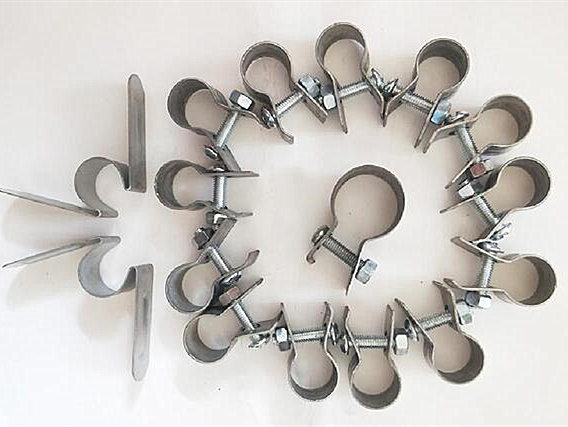
Clamp and Holder
Silicon Carbide Clamp
Review clamp types, stainless steel construction, diameter reference and MoSi2 holder groups.
View clamp details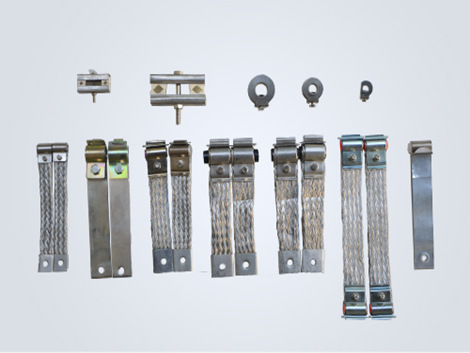
Connection Tape
Conductive Connection Tape
Review braid types, aluminium strap construction and stress-control guidance for the cold end.
View tape details
Accessory Category
Heating Element Accessories
Compare clamp and connection tape scope for SiC and MoSi2 heating element installations.
View categoryFAQ
Should heating element clamps and connection tape be replaced together with the element?
They should be inspected every time an element is replaced, and replaced whenever the contact surface is oxidised, deformed, discoloured or loose. A new element connected through a degraded clamp or strap can develop a hot joint at the terminal, and the resulting damage is often blamed on the element rather than on the connection.
Why does a heating element connection strap turn black, crack or break?
Discolouration and cracking at the strap normally indicate resistive heating at the joint rather than a fault inside the element. Common causes are a loose clamp, an undersized strap for the operating current, a strap pulled tight enough to transfer mechanical stress to the cold end, or oxidation on the contact surface. Record terminal photos before removing anything, because the damage pattern helps identify the cause.
Can a heating element clamp be reused if it still looks intact?
Only after checking that it still holds stable contact pressure and that the contact face is clean. Visual condition alone is not sufficient, because spring tension is lost gradually through thermal cycling and an oxidised contact face can look acceptable while still raising joint resistance. If the replacement element has a different cold-end diameter, the clamp must be re-selected regardless of its condition.
To review clamp and connection tape scope for a replacement project, send the data through the RFQ form, visit the Contact Us page or email info@hnlasting.com.